Rapid Rehousing is a well-respected strategy for ending homelessness and is rightfully held in high esteem by many organizations such as the National Alliance to End Homelessness and the US Interagency Council on Homelessness. HUD’s brief (since removed from HUD’s site) on the program describes the program, its history, its benefits, best practices, and many links to brief research done by organizations and CoC’s.
However, unfortunately, all Rapid Rehousing projects are not necessarily implemented in ways that align with HUD’s recommendations. The entire premise of Rapid Rehousing is that all literally homeless clients who want housing are “housing ready”. It is aligned with the principles of Housing First which recognizes housing as a foundation that clients need to build their lives on and move forward. So how is a CoC to know if their Rapid Rehousing projects are doing their part to help end homelessness?
It will likely be different for every CoC, but in our particular case, the questions that came up that we wanted answers to were:
- Where are our RRH clients coming from? (ES, SH, Unsheltered? TH?) (this blog post)
- Are RRH projects requiring an income to consider a client for Rapid Rehousing? (next blog post)
- How Rapid is Rapid? (future blog post)
- How are providers spending their Rapid Rehousing and Homelessness Prevention money? What population are providers prioritizing? (future blog post)
- How many literally homeless clients are in local shelters where there are RRH/HP grants being spent on mostly Prevention? What are their outcomes? (future blog post)
These questions will of course lead to more, and I expect we will likely be working toward improving outcomes for awhile as these questions are answered.
Originally, we were looking for a way to count successful referrals from shelter to RRH, but because there is not an obvious way to tell if an Emergency Shelter client exited to RRH by using the data elements, we decided to look at this from the perspective of the Rapid Rehousing projects and not the Emergency Shelters. We built a very simple report that looks at Residence Prior to Entry on RRH clients in multiple ways.
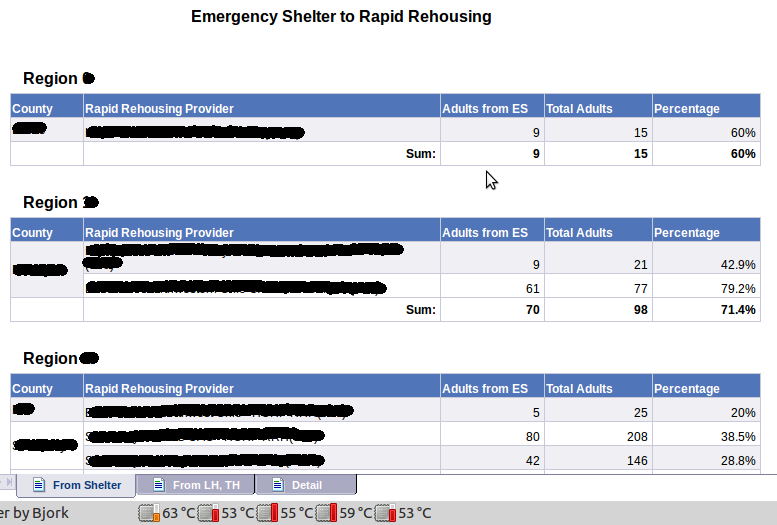
The first tab simply looks at how many clients came from shelter compared to how many adults were served by that project.
The second tab breaks that data out into all Residence Prior selections that would be allowable under Rapid Rehousing: Shelter, Safe Haven, and Unsheltered. I include Transitional Housing because in some of our more rural counties, the TH serves as the only shelter around.
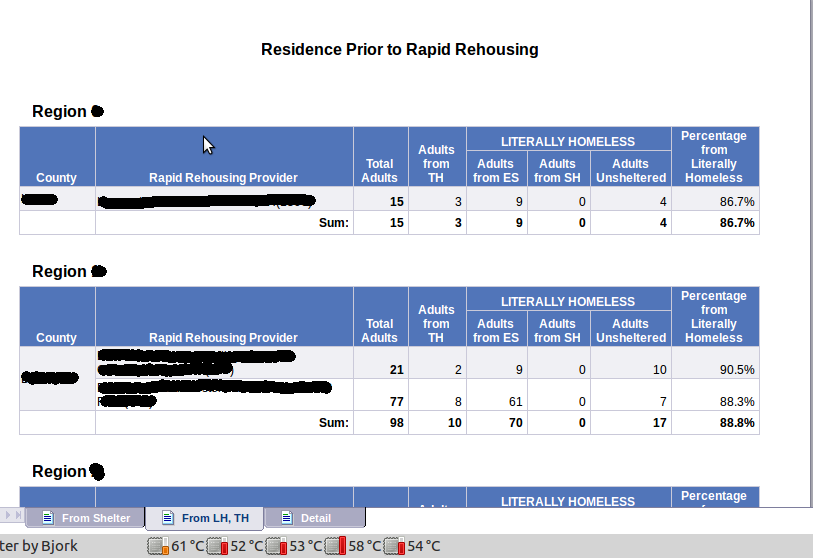
One might think that every RRH client should be counted in one of these columns on the second tab, since you can only serve Literally Homeless clients in RRH, but there are data issues, plus there are exceptions, like if the client was in an institution for less than 90 days and they can prove they were homeless just prior to that, then that’s ok too (but the data elements do not currently capture that). You can see on the Detail tab that I have those questionable Residence Priors showing in red.
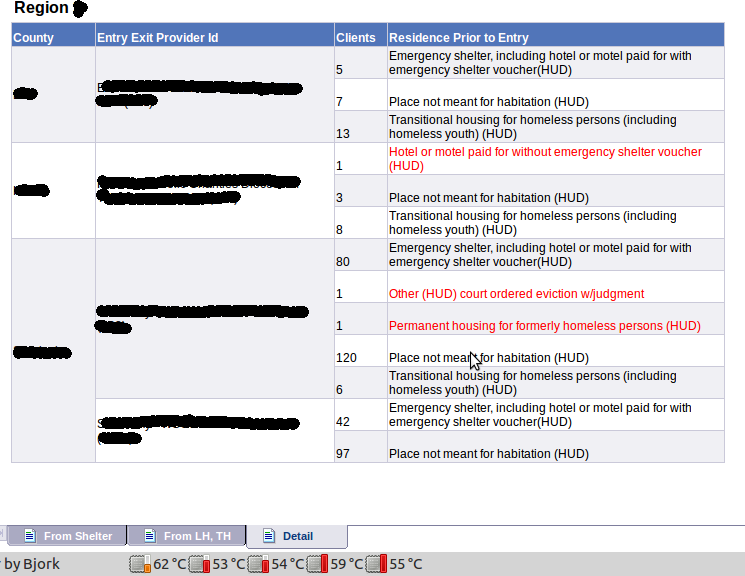
This report is used as a way of spotting problem areas in our expansive geography so that technical assistance can be focused on those providers who are either getting most of their clients from institutions, are serving ineligible clients, or are consistently answering the Residence Prior question incorrectly. You can see above on the Detail tab that a client has “Other (HUD)” and then in the comments, they wrote that they had an eviction, but that does not speak to the question of where the client slept the night before. (An eviction doesn’t automatically mean Literally Homeless…)
We also look for high numbers of Unsheltered clients where that does not match with our Point in Time Count data for that area. Either there is a tent city that’s consistently being missed every single year or there is something else going on.
Anyway, this report is just one of many that is helping us to look at our Rapid Rehousing projects and get more traction with that money toward ending homelessness. Stay tuned for the next couple of blog posts where I will detail some of the other reports we’re using to examine our Rapid Rehousing projects.